Quick Answer
Closed-cell spray foam delivers R-6.5/inch and acts as an air and vapour barrier ($1.50–$3.50/board ft installed). Open-cell is R-3.7/inch and cheaper at $0.80–$1.50/board ft but is not a vapour barrier. Use closed-cell below grade and in shallow cavities; open-cell for above-grade walls and sound-sensitive partitions.
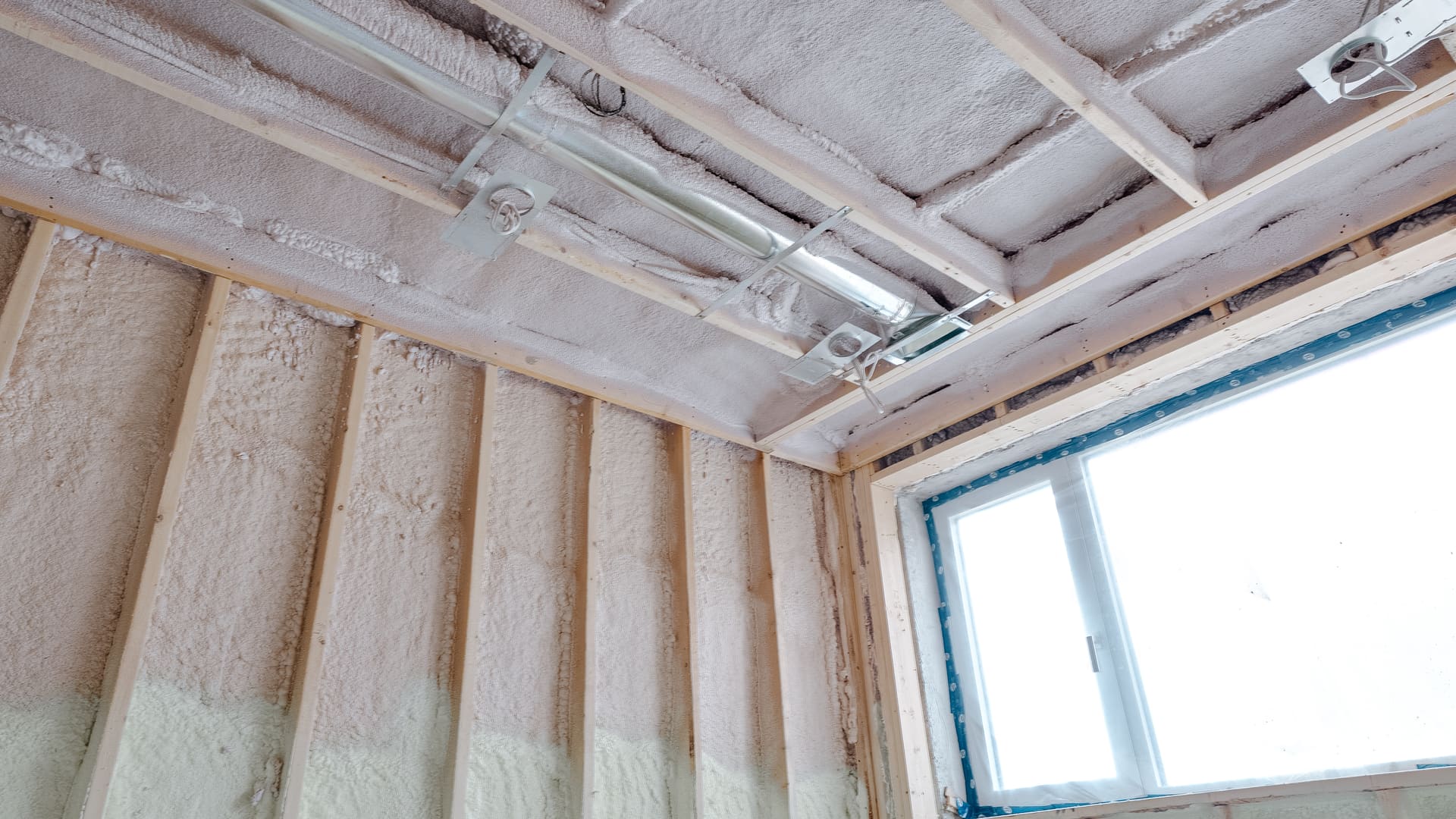
Open-cell and closed-cell spray foam are both polyurethane insulations applied as a liquid that expands into a solid foam, but they perform differently enough that mixing them up can ruin an assembly. Closed-cell is denser, costlier, and acts as an air, vapour, and thermal barrier in one product. Open-cell is lighter, cheaper, and excellent for sound dampening and warm assemblies — but it's not a vapour barrier and shouldn't go below grade.
This guide compares both on R-value, cost, vapour control, and where each is the right call in Ontario's Climate Zone 6.
Open-Cell vs Closed-Cell — Side by Side
The technical differences come from cell structure: closed-cell has tiny sealed cells holding gas (high R-value, water-resistant); open-cell has connected cells filled with air (lower R-value, more flexible, sound-absorbing). The behavioural differences in an Ontario assembly follow directly from those properties.
| Property | Open-Cell (0.5 lb) | Closed-Cell (2.0 lb) |
|---|---|---|
| R-value per inch | R-3.7 | R-6.5 |
| Density | 0.5 lb/ft³ | 2.0 lb/ft³ |
| Cost installed (GTA, 2026) | $0.80–$1.50/board ft | $1.50–$3.50/board ft |
| Air barrier? | Yes (at 3.5"+) | Yes (at 1"+) |
| Vapour barrier? | No (semi-permeable) | Yes (at 2"+) |
| Water tolerance | Absorbs water | Rejects bulk water |
| Sound damping (STC contribution) | Excellent (cellular structure absorbs) | Poor (rigid) |
| Below-grade use | Not recommended | Recommended |
| Re-entry after install | 24 hours typical | 24 hours typical |
When Open-Cell Wins
Open-cell is the right pick when:
- above-grade walls in a heated, conditioned space — interior partitions and exterior 2x6 walls in homes with proper exterior vapour control
- attics — when there's good ventilation and you want sound dampening from the roof
- sound-sensitive partitions — bedrooms, home theatres, or music rooms where the cellular structure helps with STC
- budget-constrained projects where R-value is achievable with cavity depth alone (e.g., a 2x6 wall hits R-22 with open-cell at full depth, meeting OBC zone 6 minimum).
The cost-per-R-value math favours open-cell when the cavity is deep enough to hit code minimums without compression.
When Closed-Cell Wins
Closed-cell is the only correct choice when:
- below-grade walls — basement walls always need vapour control against the foundation, and closed-cell handles incidental moisture without growing mould
- rim joists and band joists — high air-leakage zones that benefit from a thin layer of high-R-value foam
- shallow cavities — 2x4 walls hitting R-22 require closed-cell because open-cell can't get there in 3.5"
- flat roofs and unvented attics — humid Ontario summers need vapour control on the warm side, and closed-cell delivers it
- any assembly exposed to potential bulk water (rim joist of a basement, cathedral ceilings, exposed roof underside).
The higher cost is offset by better long-term durability and the elimination of separate vapour barrier products.
Cost Comparison — Same Wall, Different Foam
Cost differences widen as you scale up. A typical 1,000 sq ft basement wall (8' high × 125' long perimeter) insulated to R-20 minimum with closed-cell at 3" runs $4,500–$8,000; the same area with open-cell can't even hit R-20 in cavity space without going to 5.5" thickness, which doesn't fit a standard 2x4 stud wall.
| Application | Open-cell typical | Closed-cell typical | Recommendation |
|---|---|---|---|
| 2x4 wall, 1,500 sq ft (R-22 target) | Cannot reach R-22 | $4,000–$7,500 | Closed-cell required |
| 2x6 wall, 1,500 sq ft (R-22 target) | $2,200–$4,000 | $4,500–$8,500 | Open-cell adequate |
| Attic, 1,500 sq ft (R-60) | $3,500–$6,000 | $10,000–$16,000 | Open-cell + blown-in topup |
| Basement walls 1,000 sq ft (R-20) | Not recommended | $4,500–$8,000 | Closed-cell required |
| Rim joists, full perimeter (R-20) | Not recommended | $1,500–$3,000 | Closed-cell required |
OBC and Greener Homes Considerations
OBC SB-12 sets minimum R-values per building element in Climate Zone 6: R-22 for above-grade walls, R-20 for basement walls, R-60 for attics. Both foams meet the spec when sized correctly. The Canada Greener Homes Grant rebates apply equally to both products provided installed R-value targets are met.
For air leakage control under SB-12 prescriptive paths, both are recognized air barriers — but only closed-cell is a vapour barrier on its own. Mixing the two in a single assembly (closed-cell on the underside, open-cell as a topup) is increasingly common in cathedral ceilings and high-performance walls. We recommend specifying that approach with a building science consultant or experienced designer to avoid trapping moisture between layers.
More Resources
Sources & Methodology
R-values per inch and density figures from CCMC-evaluated product technical data. Installed costs reflect Konstruction Group’s 2024–2026 GTA spray foam projects across attics, basements, and cathedral ceilings.

Researched & reviewed by
Fadi MamarCo-founder, Konstruction Group Inc
Engineering graduate from Toronto Metropolitan University with 14+ years in Toronto construction. Has overseen 500+ residential and commercial framing, insulation, and drywall projects across the GTA.
LinkedIn ProfileExplore Our Services
Ready to Start Your Project?
Contact Konstruction Group for a free consultation and quote.
Get a Free Quote