Quick Answer
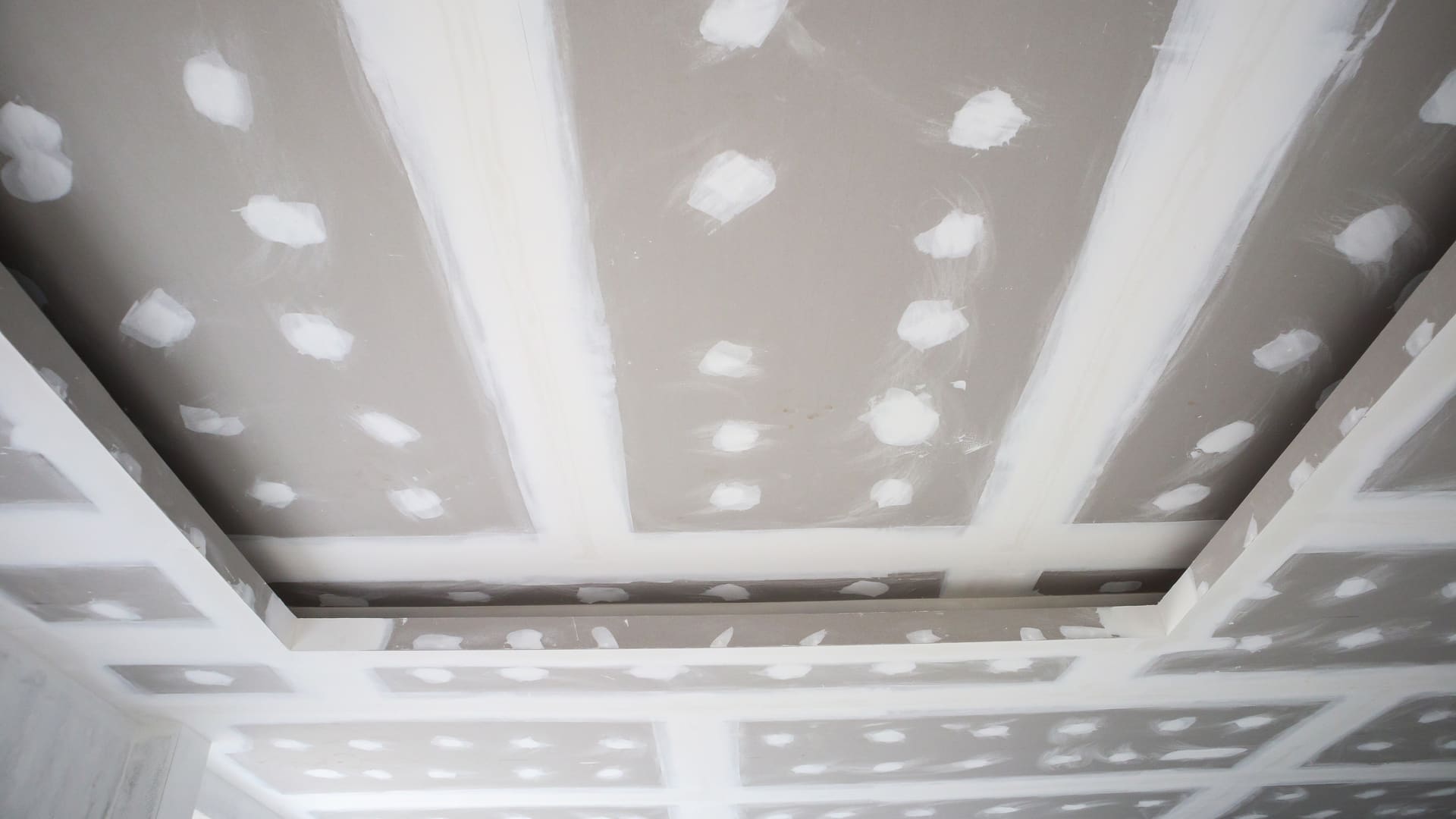
Fire-rated drywall (most commonly Type X 5/8”) contains glass fibres in the gypsum core that hold the board together during fire exposure. OBC requires it for garage-to-house walls, party walls between attached dwellings, common corridors, and shaft enclosures. A 1-hour rated assembly requires the entire UL/ULC-tested wall system, not just the drywall alone.
Fire-rated drywall (most commonly Type X 5/8") is gypsum board with glass fibres added to the gypsum core. The fibres hold the board together as it heats up, slowing fire spread through the wall. Standard 1/2" drywall fails in 15-25 minutes of fire exposure; Type X 5/8" lasts 60+ minutes in tested assemblies. This guide explains Type X versus Type C, where Ontario Building Code requires fire-rated drywall, and how ratings are achieved in real wall assemblies.
Type X vs Type C, What's Different
Both Type X and Type C are fire-rated, but they are not identical:
- Type X, most common, contains glass fibres in the core, typically 5/8" thick, achieves a 1-hour rating in standard wood-stud or steel-stud assemblies
- Type C, a proprietary blend with vermiculite added to the glass-fibre core, offers slightly higher fire performance, typically used in 2-hour and 3-hour rated assemblies, and costs roughly 30-35% more than Type X in 2026 GTA pricing.
In typical GTA residential construction, Type X 5/8" handles every 1-hour rated assembly required by OBC Part 9. Type C appears in commercial and multi-residential projects where 2-hour ratings between dwelling units are required.
When OBC Requires Fire-Rated Drywall
Ontario Building Code 2024 (as adopted and enforced in Ontario from January 2025 onward) mandates fire-rated drywall in specific assemblies:
- party walls between attached dwelling units such as townhouses, semi-detached, and multiplexes, minimum 1-hour rating, often 2-hour
- garage-to-house walls, 1-hour rated assembly between an attached garage and any habitable space
- ceilings between a garage and a room above, 1-hour rated
- walls enclosing a furnace room or service room above a specified BTU threshold
- common corridors in multi-unit residential, minimum 1-hour rated walls and ceilings
- shaft enclosures, stairwells, elevator shafts, and mechanical chases requiring 1-hour or 2-hour ratings depending on building height
- public corridors in mixed-use buildings.
In a typical Toronto single-family home with an attached garage, fire-rated drywall is required on all garage walls and the ceiling shared with the house. In a townhouse or multiplex, party walls between units use 1- or 2-hour rated assemblies. The 2024 OBC also carries forward strengthened requirements for secondary suites and laneway housing, both of which commonly trigger party-wall and garage-separation provisions.
How Ratings Are Achieved (UL/ULC Tested Assemblies)
A 1-hour rating is not achieved by drywall alone. The entire assembly gets tested and rated. The Underwriters Laboratories of Canada (ULC) maintains a directory of tested wall and ceiling assemblies with documented fire ratings, updated through 2025-2026.
A typical 1-hour wood-stud party wall assembly: 2x4 wood studs at 16" o.c., 5/8" Type X drywall on each side, fasteners at 8" o.c. on edges and 12" o.c. in the field, joints taped and finished. Change any element, such as fastener spacing, board thickness, or stud spacing, and the rating no longer applies.
GTA drywall contractors install to specific ULC assembly numbers, documented on the architectural fire-rating schedule. Screwing, taping, and finishing to spec includes pre-rocked deadeners and service penetrations sealed with rated firestop products.
Common Mistakes That Void a Fire Rating
The right drywall installed incorrectly still fails inspection:
- standard 1/2" board substituted in a rated location, the most common rejection reason in GTA building inspections
- screw spacing greater than the tested assembly specifies, typically 8" on edges and 12" in the field for Type X
- joints not correctly taped and mudded, since open joints void the rating
- electrical boxes installed back-to-back through a rated wall without firestop putty pads
- penetrations for plumbing or ducts without rated firestop sleeves
- recessed lights cut through a rated ceiling without approved rated covers
- battens or furring strips altering fastener depth from the tested assembly.
For a 1-hour rated assembly to deliver 1 hour of fire protection, every detail must match the tested assembly. Fire-rated work costs more than standard drywall because the install procedure is more demanding, not because the material alone drives the price.
More Resources
Sources & Methodology
Fire-rating requirements and tested assembly references from Ontario Building Code Part 9 and ULC Listed Fire Resistance Directory. Common rejection patterns reflect Konstruction Group’s 2018–2026 inspection records across townhouse and multiplex projects.

Researched & reviewed by
Fadi MamarCo-founder, Konstruction Group Inc
Engineering graduate from Toronto Metropolitan University with 14+ years in Toronto construction. Has overseen 500+ residential and commercial framing, insulation, and drywall projects across the GTA.
LinkedIn ProfileExplore Our Services
Ready to Start Your Project?
Contact Konstruction Group for a free consultation and quote.
Get a Free Quote